Sunday, 8 January 2012

ARD501 - Contextualising Design - 'Design Thinking'

This was the second in a series of lectures, this one given by Marisse Mari, which make up our Contextualising Design Module for this semester. 

Marisse started off by asking 'What is Design?.

The answer she gave lay in a quote,

'We are all designers. All that we do, almost all of the time is design, for design is basic to all human activity’.

Victor Papanek. ( 'Designs for the Real World', 1971.)


 He also said Design

"is the concious effort to introduce meaningful order"

Design can be anything - in the wider sense, the choices we make, the steps we take, all boil down to us 'designing' aspects of our lives - from something as mundane as selecting ingredients for a meal, through to the homes and life styles we create for ourselves.  As art and design students, in particular, the list of what makes us 'designers' is endless - for example, selecting a colour, creating a character, or composing a photograph.

Based on Papanek's views, the most important thing about design is how it relates to people .  If something isn't 'well designed' then its ability to 'relate' is reduced.

In order to create something that is 'well designed', Papanek said the ethological and ethical practises must be examined and implemented, and to this end he came up with a set of values that he called The Function Complex. This is a user centred approach to design, that called for a re-thinking in how design is approached.

This consists of

METHOD.
The 'honest' use of materials - the utilisation of the materials must be such that the best solution is achieved. 
If there is no point to introducing or using a material that is unecessary to the design, then don't do it .

USE
A design has to work - it has to fulfil its purpose, for example, an advert should persuade, a book should be understood by those it is aimed at.

There is no use giving a design features that are not needed in order for it to fulfil its purpose, simply for the sake of doing so.


NEED
The needs of the people should not be neglected by the designer. "Much recent design has only satisfied evanescent wants and desires, whilst the genuine needs of man have often been neglected by the designer" Papenek.

 Is the design catering to the actual needs of society - or to the needs that have been 'created' by fashion?

TELESIS
"The deliberate , purposeful utilisation of the process of nature and society to obtain particular goals"

The design must reflect the society that has created the need for it, and also fit into the economic society.

ASSOCIATION  
Our Psychological conditioning, often going back to early childhood, predisposes us to or against certain values.

Designers need to be aware that society has certain values/expectations for how a 'design' should work, look or perform, and recognise and work with this conditioning.

AESTETICS 
The beauty/attraction of the design.

The overall look of the design needs to be in keeping with what is being designed. 


  As well as the Function complex, in his book The Green Imperative , Papanek also states the designers need to consider the ecological impact of their designs.  The following all must be considered in order to reduce waste and pollution.


1. The choice of material.
2. The Manufacturing Process.
3.The Packaging of  a product.
4.The finished product.
5. Transportation.
6. Waste.

Marisse chose to summarised Papaneks work into the -

'THE 10 COMMANDMENTS OF DESIGN'


So, you have Papaneks ideology setting out a basis for a new approach to design that is intended to improve every aspect of what design is, what it does, how it functions and how it can best be used.


The Cox Review, a Government backed report, explored the importance of using the country's creative capabilities to enhance business productivity.

"Design is what links creativity and innovation. It shapes ideas to become practical and attractive propositions for users or customers. Design may be described as creativity deployed to a specific end”.
Sir George Cox


Marisse then moved on to discussing Design Philosophy and 'Design Thinking Mindset'

1.Design is about being human-centred.
2. Really great designers care about the people they are designing for.
3. Another attribute of design is that it is collaborative.

The development of this thinking would seem to encompass Papanek's earlier work, and add in the the need for, and the desirability of,  developing the ability to collaborate with other disciplines, in order to approach and create design that optimises how it relates to people.

The role of the designer is also examined within this context. Is the role of a designer to create 'impact' - and what is 'impact'?

Impact  can do many things -
. make a difference
. help others
. stir emotion
. persuade
. preserve the environment
. be something that is remembered


So, how does a designer aim to develop so that he or she is able to relate to people, consider the ecological and ethical values of what he or she does, collaborate and create impact?

T Shaped Designers. 


This was devised by  management consultants, and developed by IDEO. Its the model of how an individual/team/company's skill and knowledge can be adapted to a design solution.

Basically, a T shaped designer has 2 strengths.

Firstly, it is the depth of knowledge he or she has in their own specialist subject - that's the long stroke - the depth - of the 'T'.

Secondly, it is their ability to apply their knowledge to work in different contexts, how well they can collaborate and apply their knowledge in other area's - that is the 'cross stroke' - the breadth - of the 'T'


  And at the base of the 'T', at the 'roots', are perhaps  the values devised by Papanek.

The use of the term 'Design Thinking' became a catalyst for IDEO , developed and evolved by  David Kelly (Sandford Professor) and Tim Brown (Design consultant). It enforces the idea that design is more a frame of mind than a design process, and its a model that is now used world wide.

"Design thinking relies on our ability to be intuitive, to recognize patterns, to construct ideas that have emotional resonance as well as functionality, to express ourselves in media other than words or symbols."
 Tim Brown, 'Change by Design'

So its not  just about the process of design - its about its wider impact. For e.g. To take into account the 'green' impact, the impact on the needs of, and relationship with, people. So, closer look at design process is needed, in order to encompass the wider impact.


DESIGN PROCESS

An investigation by The British Design Council in 2009, explored broader knowledge and understanding of the Design process

The following information was obtained from This Site

The 'double diamond' design process model


"The double diamond diagram was developed through in-house research at the Design Council in 2005 as a simple graphical way of describing the design process
Divided into four distinct phases, Discover, Define, Develop and Deliver, it maps the divergent and convergent stages of the design process, showing the different modes of thinking that designers use.
DiscoverThe first quarter of the double diamond model marks the start of the project. This begins with an initial idea or inspiration, often sourced from a discovery phase in which user needs are identified. These include:

DefineThe second quarter of the double diamond model represents the definition stage, in which interpretation and alignment of these needs to business objectives is achieved. Key activities during the Define stage are:

DevelopThe third quarter marks a period of development where design-led solutions are developed, iterated and tested within the company. Key activities and objectives during the Develop stage are:

DeliverThe final quarter of the double diamond model represents the delivery stage, where the resulting product or service is finalised and launched in the relevant market. The key activities and objectives during this stage are:


It was also determined that there are certain constraints that need to be accepted in the design process

1. Feasibility - what is functionally possible?
2. Viability - is it a sustainable business model
3. Desirability - what makes sense to, and for, the people?


So, design thinking calls for a new approach to the design process, and the methodolgy of it can be used to become a 'T-shaped' designer, and therefore better able to deliver design solutions that are user centred, use collaboration to improve and advance the design, consider the functional, viable and financial implications and outcomes, and are morally, ethically and ecologically responsible.  Using this approach involves more than just 'creative design' skills in your own particular subject - it calls for communication skills, to allow you to communicate with the client,  and to collaborate with other disciplines.

I found this lecture incredibly complex - its taken me several hours to read up further on several of the area's it covered, and to try and condense the vast amount of information it contained into something that - I hope - makes sense.  I understand, and mostly agree with the values outlined by Papanek, and I can see how adopting and utilising the design thinking outlined can enhance and improve the whole design process, and create better designers and better, more applicable design solutions.

  If I have one 'doubt' its relating to my own work experiences, especially in a time of economic problems.  Admittedly, I haven't yet worked in a design environment, but on the basis that every body 'designs' as they go about every day life and business, I wonder if the impact isn't the same?. The long term benefits of adopting the user centred approach,  and the mindset, thinking and processes are obvious, as are the benefits on a wider scale, of the ethological, moral and ethical approaches.  However, to implement this way of working surely calls for businesses/companies to invest, both in terms of the time needed for a design to be developed, or a 'design solution' to be found, and in terms of financial input? In my experience, it became a case of cutting costs, and the ability/opportunity to implement this sort of work model wouldn't even have been considered.  Its an 'Ideal World' scenario - much as it makes sense, much as it would achieve the best results, in reality, how likely is it that the majority of companies would have the finacial ability to embrace this form of design thinking?

This lecture is one that I really enjoyed writing about, afterwards.  Although it was a lot to take in, at the point of delivery, the fact that it made me go and find out more, that I had to 'work' to to understand and present it clearly, and the fact that it did make me look at and consider my obligations to be a responsible designer, made it really interesting.

ARD501 Contextualising Design - Beautiful Losers

As part of my course, during the first semester of this year, we have a module entitled 'Contextualising Design'.  The assessment requirement of this module is that we keep a 'Reflective Journal' based on the lectures/talks. 

Journal 1 - 'Beautiful Losers'


Poster designed by Keith Scharwath in collaboration with Aaron Rose


Beautiful Losers (2008) is a documentary film, made by Director Aaron Rose,  and co-directed by Joshua Leonard.

The film looks at the work and lives of a group of artists who 'came together' during the early 1990's.  During the film, in a series of interviews, they begin by citing  their artistic influences as resting in subcultures such as skateboarding and graffiti, and in their own individual life experiences. Harmony Korine (Producer/Director and Screenwriter), for example, is filmed being interviewed in Dragons Park, where a friend of his was murdered. He gestures to the children playing happily in the background and almost gleefully tells them that they are playing exactly where his friends severed head was found. I felt this was his way of trying to demonstrate how experience influences your perception and portrayal of the environment around you, and explain how this influences an individual artists work.


Mike Mills

As the interviews progressed, it seemed like all the artists had a common theme of backgrounds that had shaped them into a group who felt 'out of step', 'angry' and perhaps, 'different' - at one point, Mike Mills (Film Maker, Graphic Designer, Artist) says "If not dispossessed, why make art?".


  This same attitude of anti-establishment and feeling out of step with 'ordinary' people could be said to be an attitude that has given rise to or developed as a common theme of many forms of subculture - the punk rock movement, for example.  In fact, several of the artists featured in the documentary listed the whole punk and hip hop pop culture as being of influence in their early work.


So, you have this group of young people, drawn together by interests in, and influences from various sub cultures, and by their shared enjoyment of expressing themselves in various art forms, from Graffitti to photography, from painting to music. There seemed to be common denominators in that they saw what they were doing as a form of communication between 'kids' like themselves - and 'kids like themselves' were, by their own varying yet similar definitions, the 'nerds', the 'geeks', the 'rebels', and the 'outsiders'.  As is said in the film at one point, they were 'speaking a language common to all' of them, despite the differences in how and why they created their art. Ed Templeton, one of the artists, says in the film , "Have fun, and make it for your friends.",  which also seemed to sum up a fairly large part of what the artists were saying was a reason for what they were doing in the beginning.

 Aaron Rose, one of this group of young artists, is also the founder of the Alleged Gallery, where they first began to exhibit their work. In an interview with CircleCulture Magazine, written by  Johann Haehling von Lanzenauer on 13th February 2002,  he describes how he came to be in New York, and how without any real plan, and more by chance, he came to start the Gallery.


Aaron Rose, photograph from CircleCulture Magazine


                         "I was playing in a band when I was here, a duo called Cat Furniture, and my partner was insane. We thought: let‘ s get out of here; I got friends over there in NY. We took a Greyhound bus to NY and I slept through it. It was only supposed to be for a short trip, but I stayed. NYC is the best place for a young person in America. It’s the best place to spend your 20‘ s. So that‘ s how I got to NY. I was 19 when I got there. After a few months, the band broke up. My partner got crazy. He thought he was Jesus Christ and took all his clothes off and got arrested and put into a hospital. I never saw him again. So I was alone there and didn‘t know what to do there. I met this woman and she offered me a store space.
It was very cheap in a bad area of town. The neighborhood was just heroin and crime etc. We opened this art gallery not knowing what we wanted to do. I never wanted to be an art dealer. I didn‘t have any art world experience. I just had a space and so we started putting up shows and we called the gallery Alleged after these (alleged) good luck candles that they sold in the Puerto Rican grocery stores. It was an Alleged gallery, not really a gallery. At the time I was in LA I was really into the punk and skateboarding world. And then when I got to NY I was skating and met some graffiti artists and we just started doing some shows along those lines over the years."


Alleged Gallery

 All this points to a group that started off with no ambitions or designs on commercial, or any other form of success, or with any idea of how - or even if - their group would develop or grow.


Barry McGee


 Watching the film, I found I had a variety of responses to what I was seeing and hearing, throughout. Barry McGee's (Twister) graffiti and other art work, and his description of it and his influences, I found credible and interesting 


Barry McGee at work


Chris Johanson, pictured here with his wife, Jo Jackson, also one of the artist


But although I like some examples of Chris Johanson's work, what he had to say struck me as pretentious in the extreme, and actually left me wondering exactly what they guy was on!  Or perhaps he was working just a little too hard at appearing 'cool and edgy' ?


I initially hung the same label of 'pretentious' on Mike Mills, as he described how the angst of a long ago breakup still affects his work to the present day - but then, his comment about 'why not be funny', and his attitude as the film progressed, made me consider that he was actually being very tongue in cheek and perhaps making fun of 'pretentious' attitudes.  Far more truthful, in my perception of what he had to say, was his comment that making films allowed him to express issues and feeling that he was discouraged from expressing when young.


This quote is taken again from The CircleCulture Magazine interview with Aaron Rose

"...At the beginning it was considered kid stuff or not real art because most of it is unschooled. Some artists maybe had a small art education but very few master degrees,"

As the film progressed, it charted how gradually, the work of the artists involved, and the artists themselves, began to be more accepted by the 'mainstream' art world, as opposed to the attitude that Rose outlines in the quote above.

Geoff McFetridge is an example of just how commercially acceptable some of the artists featured have become. His work has featured in everything from Pepsi advertising campaigns . .


. . . to this range of Nike dunks


Similar success for many of the artists involved, have led to the group's collective activities and achievements as being described in such terms as they ...

"became the benchmark for a movement that transformed both the art establishment and popular culture." ( From an article on www.bainspiration.com, By Paula Alvarado)

In the film, several of those featured talked about the affect of commercial success on their work and on their attitude and motivation.  Some artists went to great lengths, it seemed to me,to justify their work becoming so commercially viable, as though they had to excuse it being so, lest it be considered 'uncool', or in case anyone might think that they had 'sold out' by becoming successful. There were a few comments about the money not 'mattering' and insisting that they work for 'arts sake' alone.  I felt rather cynically that they maybe protesting too much - well, it appears that they took the money, doesn't it?  And, to be honest, I can't really see what is wrong with becoming successful and even wealthy from the art that you create. Surely, as long as you remain honest to your influences and believe in what you are creating, accepting money and/or gaining success and recognition for it shouldn't change the integral value of what you produce?

Some admitted that it made them feel more valuable to have their work appreciated on a wider level, and one view expressed was that commercial success was like 'getting back at all the mainstreams who originally dist (dismissed) the artists'.

I found it somewhat inspirational that at the end, the one thing that they all seemed to have consensus on was that despite what many of them saw as the pitfalls of commercial success, the group to this day maintain close contact. Most claimed that this kept them 'grounded' and ensured that art remains the focal point of their association and work - and it seems likely that it does.

I enjoyed this film - despite the odd moments of frustration at some of the more pretentious and outlandish comments. Some of the art work shown really appealed to me, and I felt a lot of the artists (though not all!) were articulate and interesting to listen too.  It was a slightly different slant on the old argument about success negating happiness and integrity, and I liked the way it was filmed and presented.

However, whilst I have no objections to watching films as part of lectures, a session spent just watching a film, with no real time given to discussion/direction or information giving, either during or after it, isn't really what I would call a 'lecture', any more than if we had walked in, sat down, been told to read a book - and then write about it.  I would have liked, especially as I did find the films content and theme to be interesting, to have maybe been presented with specific questions/opinions about aspects of it, that would have raised issues that I maybe didn't consider just from viewing it, for example - the film was 90 minutes long, surely there was something more substantial that could have been said at the end of it, to provoke response and give us some starting point to 'get our teeth into'?.

Thursday, 5 January 2012

Module ARD 502 - The Message - Percussive Rhythm

Instructions Given -

"Capture live action images that contain distinct sounds (excluding musical instruments) and form a visual soundtrack. Base your imagery on a theme and use a multi-screen approach.  Use at least 40 images.  Try to keep rhythm in both the audio and the visulas.
Consider this assignment as having a comercial message, your subject matter should be used in a way thst conveys a message to a particular audience with considered objectives (what are you saying, and who are you saying it to?) . 2 to 4 minutes in length."

This I found a very challenging unit to complete.  Not in terms of coming up with an idea - I had several that I explored before committing to the final concept. Not in terms of mastering the actual editing techniques either - thanks to a really informative tutorial session by Simon, they were quite simple to grasp.  Nope, the problem lay in that in order to 'try to keep rhythm' some musical, rhythmic ability is necessary - and I personally am less rhythmically gifted than your average cart horse!

In terms of an idea for finding both sounds and accompanying visuals, there was a wealth of potential material that I came up with - I spent an hour in the bathroom, listing the different sounds I could find, and had no trouble finding way over the 40 suggested as an appropriate number - I also looked at 'sounds of the car', 'sounds when baking', even looked at the different sounds made by a selection of different doors opening and closing.  Equally, coming up with a potential commercial use for those themes was pretty simple - the bathroom sounds could be used for anything from bubble bath, to bathroom fittings.  But, I wanted something a little different, and took advantage of my DH's hobby of home brewing, to develop a theme for my final choice.

I spent one very chilly day, following my DH round his 'brewing shed' as he made an American pale ale from the grain.  There were a massive amount of different sounds to 'collect' - from the actual grains being poured, to the sound of the scales as they were weighed;  The different sounds made as the different pieces of equipment that are used - the metallic 'clink' of the catches on the mash tun, the 'thunk' of a bucket handle, the 'snap' of the refractometre (used for measuring the alcahol content of a beer) and the sounds of the process - the liquid pouring into a bucket from the copper, the bubbling of the wort as it simmered, the liquid sounds of 'sparging', the grain hitting the brew as its added, the 'rustle' of the dried hops - right through to the end result of a pint being poured, the taps being operated and even the satisfying 'glug' of the finished brew being sampled.  Although not the main focus of this assignment, I really liked the visual images that accompanied these sounds too.

Commercially, this could be used to advertise home brewing equipment, a home brew web site or magazine, it could be used in a 'self sufficiency' or DIY  feature/advertisement, it could just be used to advertise a particular brand of grain, or hops.  With the commercial aspect in mind, I asked if the final image could be the sound and visual of a person taking a long taste of the finished brew, and it end with a satisfied 'sigh' and I was told this was completely acceptable.  This I felt, would add to the commercial appeal for the target audience .

Editing took quite a while, mainly down to, as I have said, the fact that I have absolutely no musical ability - Simon had showed us how to edit by adding a sound, then using that same sound as a 'space' between beats, then laying a time line of several 'beats' to form a base line for the piece.  The sounds added as spaces could be 'muted' on a separate line .  In the end, this just doubled the timelines for each sound used , which added visual confusion to the problems I was having creating a rhythmically musical piece.  Half way through my first attempt, finding that the settings on the mac had somehow been changed, which further confused the timelines, didn't add anything to my enjoyment of this assignment !  Eventually, after much experimentation, and being determined not to give up, and equally determined to produce a decent piece of work, I found that creating one bar, then repeating it, was a far easier and more effective approach for me personally to take.  Once I got that idea in my head, I found that even I could come up with a piece that sounded pretty good ! The actual process of cutting the clips, reducing them to the required size, and placing them where I wanted them was very straightforward and not difficult to master.

Here is the finished piece - MUSICAL BREW

Sunday, 6 November 2011

A Return to 'Never work with Children ...'

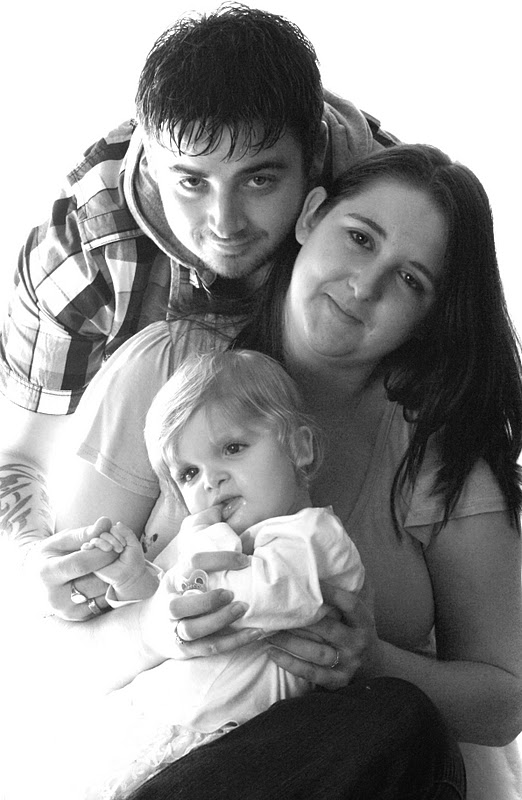
I recently had the chance to do a little more children's/family portraiture, this time featuring Mum and Dad, Emma and Sean - and their adorable little girl, Caira Grace.

Caira had a bit of a tough start to life, and in just over 12 months had faced several serious surgeries. Shortly before this shoot took place, Emma and Sean had been told that Caira needed no more major surgery, so this shoot was by way of a little celebration of the fact that this little girl had finally managed to overcome some very major health issues and they could now really start to enjoy a 'proper' family life without any shadows hanging over them.

Caira was an absolute delight - the determination that she obviously has was evident - it wasn't time for silly picture taking, in Caira's mind -  it was time for shaking her head 'No', pulling tongues - and snuggles with Mum and Dad.  Yet again, it was re-enforced that you don't have to have constant beaming smiles from the little ones - go with what they want, at their pace, and you can still get some really nice photographs.  Again, I went with very high key lighting, but I also tried to get a slightly softened look, and also a 'halo' effect with the lighting  on some of the shots.  And again, the best shots, for me, were the more informal ones, where all 3 were relaxed, and not really posing, just interacting normally.

Huge Thanks to Emma, Sean and Caira for letting me take these pictures - once again,. the phrase  'Never Work With Children . . . ' proved to be totally wrong, and I really enjoyed this session .